
Education:
- Ph.D. University of Illinois at Urbana-Champaign
- B.S. Department of Molecular Biology and Genetics; Bogazici University; Istanbul, Turkey
Professional Experience:
- Postdoctoral; Biosciences Division; Argonne National Laboratory; Argonne, IL.
- Postdoctoral; Geographic Medicine and Infectious Diseases; Tufts - New England Medical Center; Boston, MA.
Areas of Expertise:
- Biofilm formation in bacteria
- Bacterial signaling mechanisms
- Polyamine synthesis and transport in bacteria
Research:
Bacteria are incredibly versatile in the number of strategies that they utilize to deal with the changing conditions in their environments. I am mainly interested in studying how bacteria use these strategies to sense and respond to their environments. What signals do they respond to? Which signal transduction networks are responsible for sensing and processing the various types of signals? What are the physiological, behavioral and gene expression changes that occur because of these signals? We are asking these questions in the context of biofilm development by the aquatic bacterium Vibrio coralliilyticus, a coral pathogen. Biofilms are surface-attached microbial communities encased in a self-made matrix of mostly polysaccharides. Biofilm formation has been implicated to play role in the association of V. coralliilyticus with its coral host. Thus, studying the mechanisms that regulate biofilm formation in V. coralliilyticus is important for improving our understanding of coral disease and for supporting efforts to protect coral health worldwide.
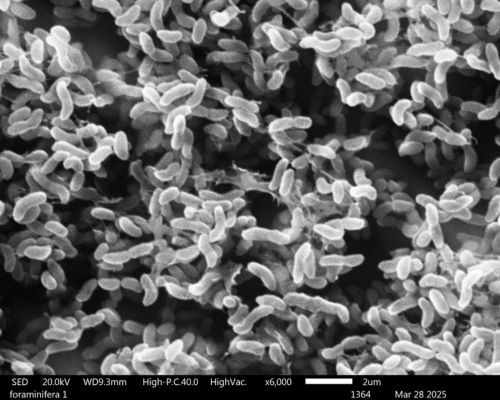
Scanning electron micrograph of a V. coralliilyticus biofilm formed on a glass slide. (Afton Rogers, Karatan Lab)
Selected Publications:
Brooks, C., Brooks, S., Beasley, J., Valley, J., Opata, M., Karatan, E., Bleich, R. (2025). The influence of environmental factors on the detection and quantification of SARS‑CoV‑2 variants in dormitory wastewater at a primarily undergraduate institution. Microbiology Spectrum, 13(2). https://doi.org/10.1128/spectrum.02003-24
Young, E.C., Baumgartner, J.T., Karatan, E., Kuhn, M.L. (2021). A mutagenic screen reveals NspS residues important for regulation of Vibrio cholerae biofilm formation. Microbiology, 167(3):001023. doi:10.1099/mic.0.001023
Wotanis, C.K., Brennan, W.P. 3rd, Angotti, A.D., Villa, E.A., Zayner, J.P., Mozina, A.N., Rutkovsky, A.C., Sobe, R.C., Bond, W.G., Karatan, E. (2017). Relative contributions of norspermidine synthesis and signaling pathways to the regulation of Vibrio cholerae biofilm formation. PLoS One, 12(10):e0186291. doi:10.1371/journal.pone.0186291
Sobe, R.C., Bond, W.G., Wotanis, C.K., Zayner, J.P., Burriss, M.A., Fernandez, N., Bruger, E.L., Waters, C.M., Neufeld, H.S., Karatan, E. (2017). Spermine inhibits Vibrio cholerae biofilm formation through the NspS‑MbaA polyamine signaling pathway. Journal of Biological Chemistry, 292(41):17025–17036. doi:10.1074/jbc.M117.801068
Cockerell, S.R., Rutkovsky, A.C., Zayner, J.P., Cooper, R.E., Porter, L.R., Pendergraft, S.S., Parker, Z.M., McGinnis, M.W., Karatan, E. (2014). Vibrio cholerae NspS, a homologue of ABC‑type periplasmic solute binding proteins, facilitates transduction of polyamine signals independent of their transport. Microbiology, 160(5):832–843. PMCID: PMC3992718
Goforth, J.B., Walter, N.E., Karatan, E. (2013). Effects of polyamines on Vibrio cholerae virulence properties. PLoS ONE, 8(4):e60765. doi:10.1371/journal.pone.0060765
Parker, Z.M., Pendergraft, S.S., Sobieraj, J., McGinnis, M.M., Karatan, E. (2012). Elevated levels of the norspermidine synthesis enzyme NspC enhance Vibrio cholerae biofilm formation without affecting intracellular norspermidine concentrations. FEMS Microbiology Letters, 329(1):18–27. doi:10.1111/j.1574-6968.2012.02498.x
McGinnis, M., Parker, Z.M., Walter, N.E., Rutkovsky, A.C., Cartaya‑Marin, C., Karatan, E. (2009). Spermidine regulates Vibrio cholerae biofilm formation via transport and signaling pathways. FEMS Microbiology Letters, 299(2):166–174.
Karatan, E., Watnick, P. (2009). Signals, regulatory networks, and materials that build and break bacterial biofilms. Microbiology and Molecular Biology Reviews, 73(2):310–347. PMCID: PMC2698413

Title: Professor, Molecular Microbiology
Department: Department of Biology
Email address: Email me
Phone: (828) 262-2857